
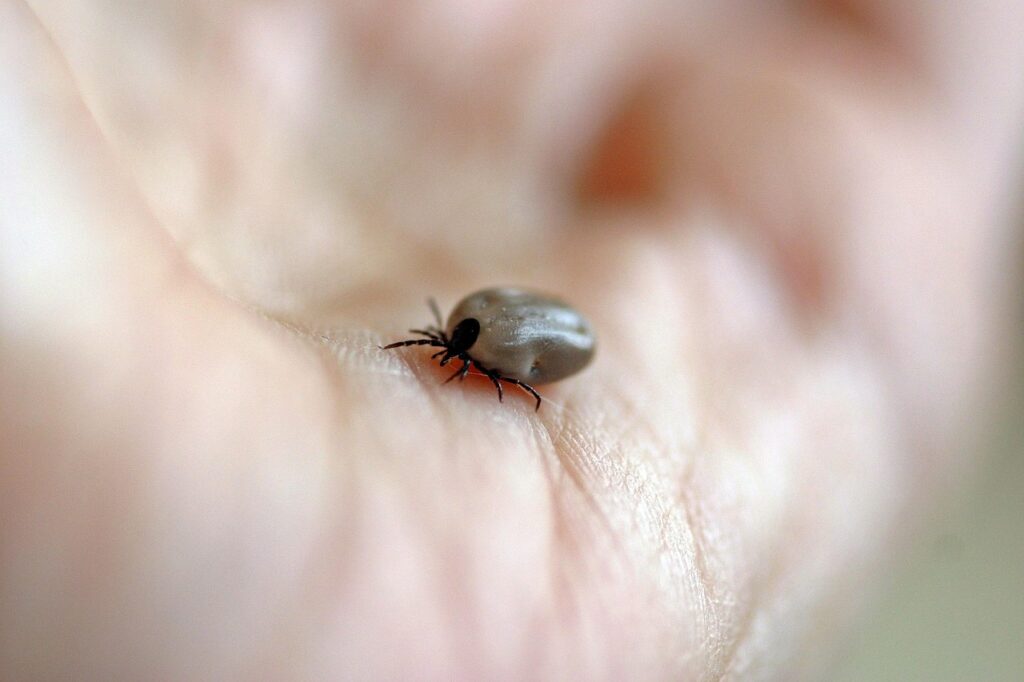
Early in the morning on the bed, on the duvet. Unmistakeably a tick. Small, but not tiny. Fully engorged.
The first thing I did, was to discard it by taking a tissue and picked the well-fed tick up and flushed it. Gone for good. I realised later that was not a good idea, as I destroyed any chance to later identify it.
Where was the tick all the time that it had a chance to feed and become fully engorged? On me? On my dogs?
I regularly treat my dogs with Revolution and the tick looked slow, so maybe it was dying. Or, it was just slow because it was so full.
I looked with a comb all over the two dogs and did not find anything else resembling a tick or a flea or any other kind of parasite that I could see with the naked eye.
I inspected my body all over as best as I could, even with the help of a mirror. Then I started searching the internet. I should never have flushed the tick!
Canine Babesiosis/biliary/tick fever. Parasitic. The parasite attacks and destroys red blood cells, causing severe haemolytic anaemia. I don’t want my dogs to get that. I checked them again and could not see anything resembling a bite mark. It was futile, as the bite mark could be so tiny that even with the short, trimmed fur I would not be able to see the bite mark.
Canine Ehrlichiosis/tick bite fever/bosluiskoors. Bacterium. The bacterium attacks white blood cells and can impair the immune system.
If someone was bitten, it should be me. I don’t want my dogs to get any of the above.
African Tick Bite Fever (ATBF): This is the most common tick-borne infection in South Africa. It is caused by Rickettsia africae bacteria, typically transmitted by Amblyomma ticks (cattle or game ticks). Symptoms include a fever, severe headache, swollen glands, and a black, crusty mark at the bite site (known as an eschar).
So now I am regularly checking my skin for an eschar. Everywhere.
I am also keeping a close eye on the dogs, and I have washed all bedding and mopped and cleaned.
There are more diseases. Apparently, precautionary antibiotics is not a thing. So, now it is just a waiting game. Waiting and observing.
If you have been bitten by a tick, look out for the following symptoms, which usually appear 5–7 days later:
- A “black spot” or eschar: A black, necrotic spot at the site of the bite.
- High fever and chills.
- Severe headaches.
- Swollen lymph nodes near the bite.
- A rash: Sometimes appearing on the palms and soles.
OK, so the tick was fully engorged and I discovered it on the bed on Tuesday. Today is Saturday. If I count from Tuesday, today is day 4. If the tick started feeding earlier on Monday or Sunday, today could be day 5 and even day 6.
For the dogs, the waiting times are worse:
The incubation period for canine babesiosis is typically 10 to 28 days after a tick bite, though it can range from a few days to several weeks depending on the species.
Canine Ehrlichiosis typically has an incubation period of 1–3 weeks (8–20 days) after the initial tick bite before acute symptoms appear. Following this, the disease may progress through acute (2–4 weeks), subclinical (months/years), and chronic phases. Some dogs may remain sub-clinically infected for life.
What worries me, is the fact that the tick was clearly fully engorged, and from that my understanding is that it had enough time to transmit a disease.
Mediclinic has some good news, that not all tick bites result in tick bite fever.
Linden Vet has more info about tick fever vs tick bite fever.
Dogsfirst describes the fully engorged tick that I have found on the bed perfectly. Like a small grey bean.
I could have gotten the tick outside, the dogs could have gotten it outside, and the Saturday the dogs went to the doggy parlour, and a tick could have hitched a ride back home.
Whatever the case, the tick was on the bed and now it is just monitor and wait.
In the old days, I people used kakiebos to keep fleas and ticks at bay. If it works, I have no idea. For now, I have got Ultrum powder to lightly dust the dogs every few days when we go out for walks and there will be long grass etc. Their next dose of Revolution is due in a little less than 3 weeks.